What is the difference between a 3 axis, 4 axis or 5 axis bridge saw?

Overview
- Bridgesaws are a staple in stone shops. The number of axes determines what can be done on them
- 3 axis models are the most common; however, they’re not always the most efficient
- Knowing which option to choose requires thorough analysis of your overall process
Bridgesaws have always been a staple in modern stone shops. While one of the common questions stonemasons ask is “do I need a monobloc or gantry bridgesaw”, there is a more fundamental question to answer first: “Do I need a 3 axis, 4 axis, or 5 axis bridgesaw?”.
The answer depends on a variety of factors. Detail work, speed, size, and energy costs are all elements that play into the decision-making process for which machines to have on your shop floor.
Let’s take a deep dive into each of them.
3 axis vs 4 axis vs 5 axis bridgesaws at a glance
- 3 axis: the blade travels along the slab, across it, and up and down. It suits straight, square cuts. Angled cuts mean turning the slab or the head manually.
- 4 axis: adds a rotating head, so the blade can cut in any direction across the slab without the piece being moved.
- 5 axis: adds a tilting head, usually from 0 to 90 degrees. All five axes work together for mitres, bevels, curves and shaped cuts in a single setup.
Is it worth paying double for a 5-axis CNC over a 3 or 4-axis saw?
While 5 axis CNC machines are a more significant investment compared to 3 or 4 axes, they also allow for greater productivity. For those working on more complex shapes, 5 axis bridgesaws are able to perform more operations on the one machine, reducing the need for repositioning and loading and unloading.
For the stone industry, this is a major advantage. On a 5 axis bridgesaw, you’re able to cut complex L-shaped countertops and vanities, 45 degree bevels, and sink and stove cutouts without moving the piece. From there, any finishing can usually be done on 1-2 additional machines; whether they’re edge polishers or machining centres.
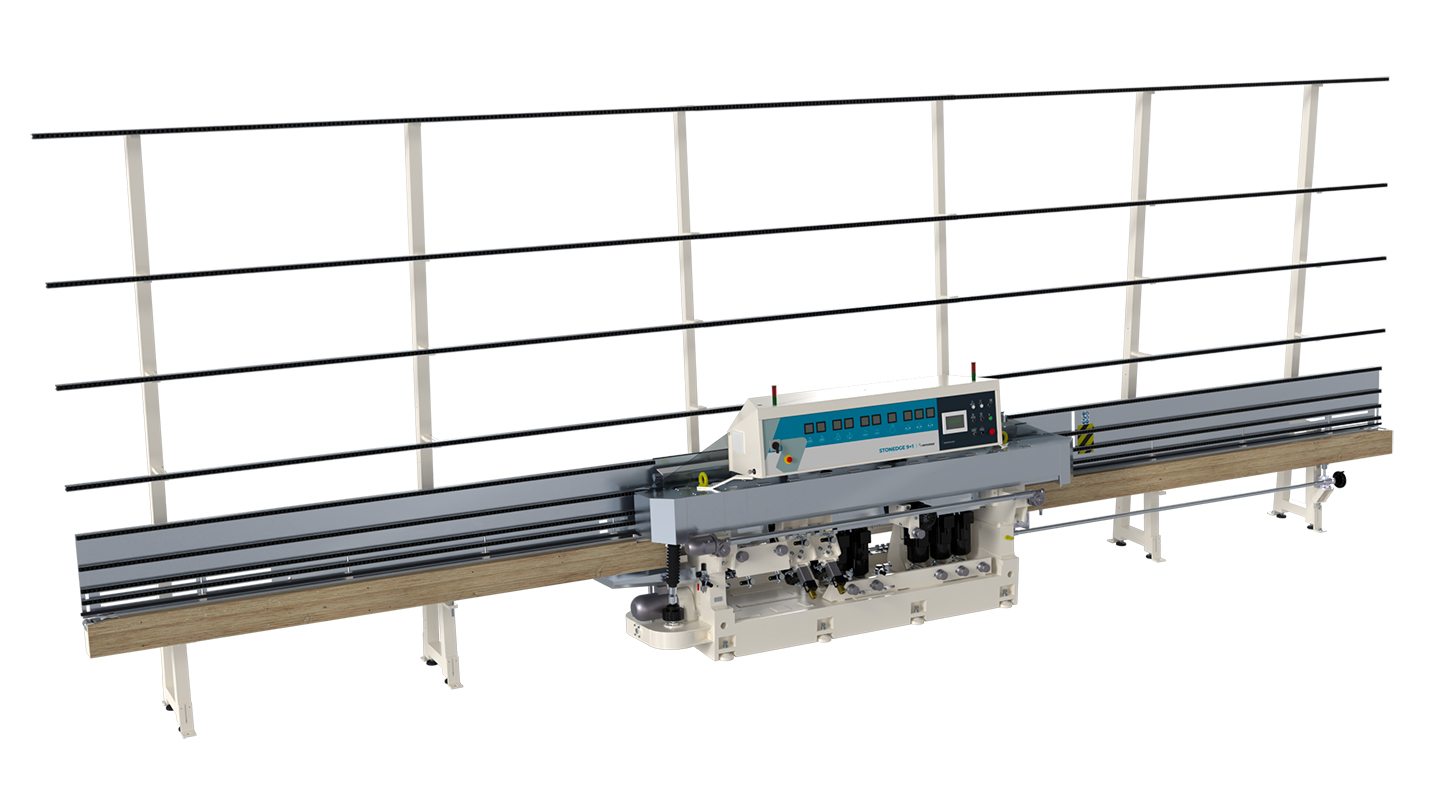
Alternatively, models like the Bovone Stonedge 9+1, a recent addition to our collection, are made specifically for benchtop production. Deciding which option is right for you depends on a variety of factors. Including:
- Existing equipment
- The skill of your labourers
- Business goals
- Factory footprint, and
- Overall workflow
If you think that upgrading to a 5 axis would be advantageous for your shop, let our experts know. We’ll do a thorough analysis and share our thoughts on the matter.
Do I still need a waterjet if I buy a 5 axis bridgesaw?
While upgrading to a 5 axis bridgesaw brings many benefits, including less reliance on labour, there are a number of reasons why pairing it with a waterjet is beneficial.
Aside from versatility, waterjets excel in:
- Precision; especially for tight tolerances
- Efficiency executing detail work like cutouts and holes
- Cutting sharp inside corners smoothly, and
- Minimising material wastage
For many stonemasons, the most efficient setup is to do rough slab cutting on the 5 axis bridgesaw, then move to a sophisticated waterjet like the Smartline or Easyline for rounded corners and other detail work. If any extra details are required, a 5 axis CNC like the CMS Speed completes the workflow.
The benefits of combining a 5 axis bridgesaw with a waterjet don’t just apply to part quality. It’s also a far less hands-on arrangement, requiring minimal labour to complete tasks. That means less exposure to silica dust, less human error, and less risk of machine downtimes if staff are unavailable.
Waterjets on their own are one of the best machines to own, especially in a rapidly changing world. Whether you choose to combine it with a 5 axis bridgesaw depends on your overall workflow and needs.
The overall quality of both waterjets and 5 axis machines varies greatly. Longevity, customisation, and learning curves are all factors when making a purchasing decision, as is support. Many stonemasons find that it’s better to go the safe route and invest in established European brands over cheaper imported models. The below example illustrates why.

What am I paying for if I buy a premium European bridgesaw over an imported one?
The difference between investing in a premium European bridgesaw vs an imported machine isn’t just in the build itself. It’s also in the service.
While European models like those from CMS and Bovone stem from a long legacy of premium builds, thoughtful optimisation, and customisation features, the details matter. Accessibility to spare parts, tooling, and support is essential to keep these machines running; something that isn’t always guaranteed when purchasing imported models.
Paul from SP Stone outlined this exact scenario as a key factor for investing in a CMS Kosmos with us. After having an imported bridgesaw sitting in their shop with no one to support them, the company looked for local options that would enable them to make full use of their asset.
The CMS Kosmos, with our support, gave them the confidence and capacity to make major productivity leaps. Read the full testimonial for details.
Frequently Asked Questions
What is the difference between a 3, 4 and 5 axis bridge saw?
A 3 axis bridge saw moves the blade along, across, and up and down for straight cuts. A 4 axis saw adds a rotating head so it can cut in any direction. A 5 axis saw also tilts the blade, allowing mitres, bevels and shaped cuts without moving the piece.
Is a 5-axis saw genuinely worth the premium for my job mix?
If most of your work is straight cuts, a 3 or 4 axis saw may be all you need. If you regularly cut mitred edges, L-shaped countertops, vanities and sink cutouts, a 5 axis saw performs more operations on the one machine and reduces repositioning, loading and unloading.
Do I need a monobloc or gantry bridgesaw?
A monobloc bridgesaw is built on a single frame, so it is quicker to install and takes up less floor space. A gantry bridgesaw runs on separate supports, which suits larger slabs and higher volumes. The right choice comes down to your factory footprint and workflow.
Are installation, calibration, and onsite training included in the quoted price?
It varies between suppliers, so ask for it in writing. Check whether the price includes freight, rigging, installation, calibration and training, and what support looks like once the machine is running. Talk to our team about what is included with our machines.
What is the true total cost of ownership for a bridgesaw over the course of a year?
The true total cost of ownership for a bridgesaw over the course of a year is calculated based on a variety of factors, including:
- Purchase price and finance costs
- Freight, rigging, installation, and training
- Blades and tooling
- Power and water
- Servicing and spare parts
- Downtime when the machine isn’t running
- Labour to operate it
Does a 5 axis bridgesaw help reduce silica dust exposure?
It can. Cutting is done wet and more of the work stays on the machine, which reduces manual handling and dry finishing. Machinery is only one part of meeting your obligations, so check the current Safe Work Australia guidance on silica and engineered stone.
Related Articles
 https://www.innovync.com.au/wp-content/uploads/2026/10/glasstec-2026-cms-stand.jpg
1500
2000
Nicole Sherwin
https://www.innovync.com.au/wp-content/uploads/2022/07/Innovync-logo.png
Nicole Sherwin2026-10-27 09:18:542026-10-27 10:25:38Glasstec 2026 Wrap: Three Things We’re Bringing Home
 https://www.innovync.com.au/wp-content/uploads/2026/10/glasstec-2026-preview-innovync.jpg
400
1200
Nicole Sherwin
https://www.innovync.com.au/wp-content/uploads/2022/07/Innovync-logo.png
Nicole Sherwin2026-10-12 09:22:112026-10-12 09:22:12Glasstec 2026: What We’re Going to Düsseldorf to See
 https://www.innovync.com.au/wp-content/uploads/2026/06/Website-Headers.png
600
1920
Nicole Sherwin
https://www.innovync.com.au/wp-content/uploads/2022/07/Innovync-logo.png
Nicole Sherwin2026-06-18 14:07:482026-09-17 12:26:30Australian Manufacturing Grants Guide: Spotlight on the $79.1M Transforming Queensland Program
 https://www.innovync.com.au/wp-content/uploads/2026/06/9bca65cb-351a-47ca-b32f-6eda021c189b-scaled.jpeg
1708
2560
Nicole Sherwin
https://www.innovync.com.au/wp-content/uploads/2022/07/Innovync-logo.png
Nicole Sherwin2026-06-18 13:31:492026-09-17 12:24:08Service: the biggest competitive factor in manufacturing
 https://www.innovync.com.au/wp-content/uploads/2026/09/robot-arm-grippers-for-industry-in-factory.jpg
788
1400
Nicole Sherwin
https://www.innovync.com.au/wp-content/uploads/2022/07/Innovync-logo.png
Nicole Sherwin2026-04-29 13:49:072026-09-17 12:24:09Manufacturing Robots: The Good, The Bad, and The In-Between
 https://www.innovync.com.au/wp-content/uploads/2026/04/byd-assembly-line.jpg
1080
1920
Nicole Sherwin
https://www.innovync.com.au/wp-content/uploads/2022/07/Innovync-logo.png
Nicole Sherwin2026-04-29 13:31:062026-09-17 12:24:09The Rise of Dark Factories
 https://www.innovync.com.au/wp-content/uploads/2024/05/pexels-kateryna-babaieva-1423213-2760241-scaled.jpg
3475
5212
Nicole Sherwin
https://www.innovync.com.au/wp-content/uploads/2022/07/Innovync-logo.png
Nicole Sherwin2026-03-02 12:11:292026-09-17 12:24:09Transforming Queensland Manufacturing Grants: Up to $1.5M Available for Advanced Manufacturing Investment
 https://www.innovync.com.au/wp-content/uploads/2026/02/curved-stonework.jpg
920
736
Nicole Sherwin
https://www.innovync.com.au/wp-content/uploads/2022/07/Innovync-logo.png
Nicole Sherwin2026-02-23 16:49:352026-09-17 12:24:102026 Stone Industry Forecast
 https://www.innovync.com.au/wp-content/uploads/2025/07/systron-Processing-of-Thick-Jumbo-Glass_4.jpg
1050
1500
Nicole Sherwin
https://www.innovync.com.au/wp-content/uploads/2022/07/Innovync-logo.png
Nicole Sherwin2026-02-23 16:41:192026-09-17 12:24:102026 Glass Industry Forecast
Get in touch
Looking for the right product for you, reach to our experts and let’s chat.

